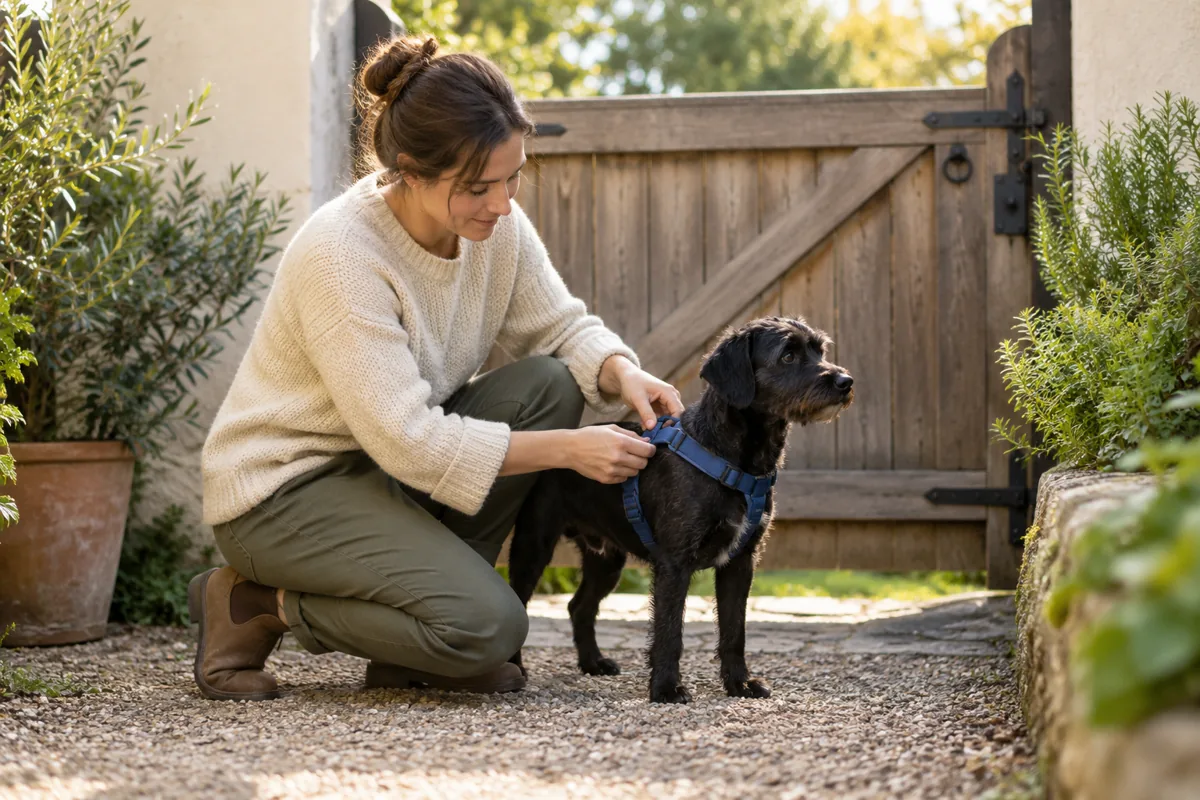
Reduce escape opportunities with secure doors and gates, properly fitted walking equipment, supervised outdoor routines, and current identification. Combine these measures rather than expecting one product or training skill to prevent every disappearance. Review the specific moments when your dog moves between home, yard, vehicle, and public space.
Prevention should fit the individual dog and household. A nervous newly adopted dog, an energetic adolescent, and an older dog with changing behavior may need different support. Ask your veterinarian or a qualified humane trainer about concerns you cannot explain or manage safely.
Walk through the exits at home
Start at each door your dog could reach. Notice where visitors, deliveries, and children create a busy transition. Decide where the dog will wait while the door is opened. A closed interior door or a suitable physical barrier may reduce access to the outside, but adults still need to check it is secured.
Make the routine explicit for guests: “Please wait while I put the dog in the other room.” A sign can remind people, but it cannot close a door. Do not rely on a visitor guessing which pet is allowed outside. If a household member has mobility or vision needs, choose a routine that is practical for them too.
After a near miss, record what happened. Did a latch fail, a door stay open, or a dog slip past two people carrying groceries? Change that step directly. General promises to “be more careful” are harder to follow than an agreed rule that the dog stays in a secure room during unloading.
Inspect the yard instead of assuming it is secure
Check latches, hinges, loose boards, gaps underneath, and objects a dog could climb. Recheck after storms, repairs, or landscaping. Ask contractors and visitors how gates will be managed while work is underway. Keep the dog elsewhere when the boundary cannot be maintained.
Supervision lets you notice digging, climbing, and repeated interest in one section. A fence is a boundary, not a guarantee. Choose improvements based on the actual behavior and local safety requirements rather than adding improvised materials that could trap or injure an animal.
Do not assume an electronic boundary stops other animals or people from entering, or physically contains a dog that leaves. Discuss containment concerns with a qualified professional. The aim is a safe environment and predictable routines, not punishment after a dog has already become frightened or excited.
Check walking equipment before each departure
Look for damaged straps, loose stitching, worn clips, and a leash connection that has not fully closed. Follow the manufacturer's fitting instructions for the particular collar or harness. Fit differs across designs and body shapes, so a generic rule is not a substitute for checking the actual product on your dog.
Watch for slipping when the dog backs away or changes direction. Ask a qualified trainer about equipment and handling suited to a fearful dog. Do not test escape resistance beside an open road. Practice in a secure controlled place and stop if the exercise makes the animal distressed.
Keep a spare leash available for a broken or forgotten item, but avoid complicated attachments that you do not know how to use. Before exiting a vehicle, check the connection while the dog is still inside a suitably secured space. One brief equipment check is easier than repairing a failure during a busy transition.
Keep identification usable
A readable tag provides a visible way to contact you. Check the number after changing phones and replace worn or illegible tags. Consider a contact who can answer if you are unavailable, with that person's permission. Do not assume every finder will use a QR code or an app.
Microchips are a separate identification layer. AAHA explains that a chip is not a GPS tracker in its microchipping FAQs. Ask your veterinary practice about scanning and registry details, then keep your registration information current. Store the chip number and ownership records privately.
A collar-mounted tracker may provide location information, but check its charging needs, coverage, subscription requirements, and attachment. A device can fail or become separated from the dog. Avoid allowing more risky freedom because an app appears to show a location; a reading is information, not physical containment.
| Tool | Useful role | Limit to remember |
|---|---|---|
| Readable ID tag | Shows a contact number directly | Can wear out or separate from the dog |
| Registered microchip | Identifies the dog when scanned | Does not provide a live location |
| Wearable tracker | May provide location readings | Depends on the device, power, attachment, and coverage |
Teach useful skills within safe boundaries
Practice returning to you in a secure setting with rewards your dog enjoys. Build gradually and ask a humane trainer for help with distractions. Keep training sessions manageable. Do not practice near hazards on the assumption that a recall command is already reliable.
Avoid punishing a dog for returning, even if the preceding delay was frustrating. Talk with your trainer about a consistent response and realistic expectations. Recall is one skill in the safety plan; it does not eliminate the need for a leash where required or where an individual dog cannot safely be loose.
Teach household members the same cues and routines so the dog is not receiving incompatible instructions. If somebody is unable to hold the leash securely, choose another adult or a suitable safer arrangement. The handler's practical ability matters as much as the equipment.
Plan around triggers you have observed
Note times when the dog tries to flee or becomes hard to manage: loud celebrations, guests arriving, wildlife nearby, unfamiliar environments, or separation from a caregiver. These are observations to discuss with a professional, not diagnoses. A sudden behavior change also deserves veterinary input.
Before a noisy event, arrange a secure comfortable indoor space and check exits. Schedule necessary walks with attention to the surroundings, and keep equipment available before opening the door. Do not force a scared dog into an exposure exercise without suitable guidance.
For a new dog, let the household routine develop inside safe boundaries. Update identification promptly, confirm who is responsible for each walk, and tell visitors how doors work. Avoid treating an early calm day as proof that the dog will respond the same way outdoors in a new neighborhood.
Make travel transitions less chaotic
Before a trip, photograph your dog and identification, confirm the contact number works at the destination, and save local animal services information. Pack the leash and essential records where you can reach them without unpacking everything. Ask a veterinarian about health or transport concerns specific to your dog.
Check lodging policies and the security of doors, balconies, and outdoor areas on arrival. Do not assume a fenced rental yard is suitable simply because the listing says pets are welcome. Inspect it first and supervise. Set the dog in a secure space while people carry luggage through open doors.
If flying, verify the operating carrier's pet requirements directly for the route and booking. Luggage rules do not establish whether a pet can travel or which carrier is accepted. Keep those questions separate when planning, and get clarification before relying on a general travel article.
Keep a ready recovery folder
Save current face and full-body photographs, a concise description, your veterinary contact, registration details, and ownership documents. Share essential access with one trusted person if useful. The folder should be private and easy to find, rather than a public post containing sensitive details.
Read the lost-dog recovery plan while you can do so calmly. Prepare a flyer template with blank date and location fields. Preparation does not predict an escape, but it reduces avoidable setup work if you need help quickly.
Choose one weak point to fix today
Check the gate latch, replace an unreadable tag, or establish the delivery-door routine. Then schedule the next review after a move, equipment change, or household change. If your dog is already missing, switch to the first-day action guide rather than delaying recovery work to redesign prevention.