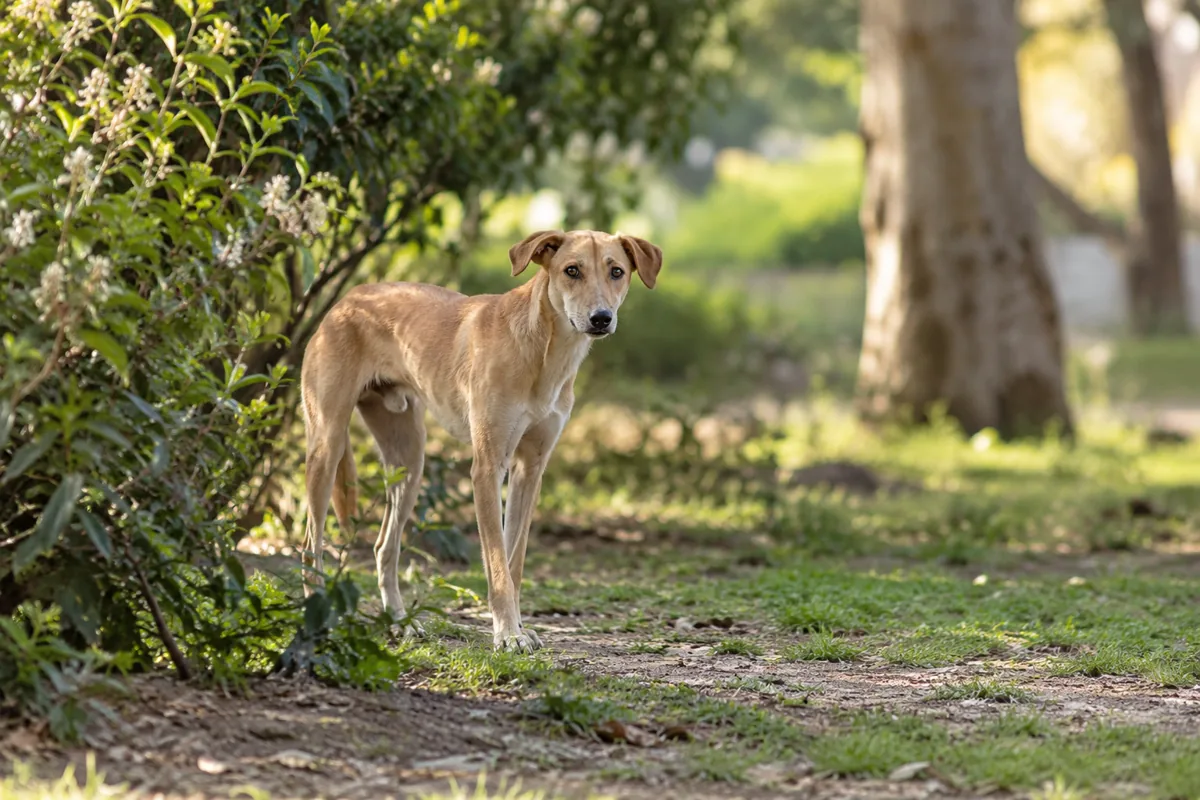
If a loose dog seems frightened, stop approaching, give the dog space, and report the location, time, and direction of movement to the owner or local animal services. Do not chase, surround, grab, or try to corner the animal. A useful sighting can help a recovery effort without requiring you to capture the dog.
The safest choice depends on the surroundings, the dog's condition, and your ability to remain at a distance. This guide explains observation and communication. It does not teach restraint, trapping, sedation, or veterinary care. Those decisions belong with appropriately experienced local professionals.
Decide whether you can observe safely
Before thinking about the dog, look at where you are standing. Are you beside moving traffic, on private property, near unstable ground, or carrying a child? Move to a safer position if necessary. Do not stop a vehicle abruptly or step into the road to protect an animal. You can help by calling from safety.
If the dog appears injured, trapped in a hazardous space, or at immediate risk on a roadway, contact the relevant local emergency or animal services channel. Give a landmark and direction of travel. Follow the dispatcher's instructions rather than trying to improvise a rescue while the call is underway.
Keep children and your own animals away. Introducing another dog can complicate a situation you do not understand. Do not use your pet as bait or a test of friendliness. If you cannot watch safely, leaving an accurate report is a reasonable contribution; you do not need to stay until someone arrives.
Read behavior cautiously
A dog that backs away, freezes, hides, or watches closely may be uncomfortable with your presence. A wagging tail alone does not establish that handling is safe. You cannot reliably diagnose a dog's history or emotional state from one brief encounter, and a familiar-looking dog may still react unexpectedly.
Describe what you see without adding labels. “The dog moved into the bushes when I stepped forward” is more helpful than “The dog is aggressive.” “Standing with weight off one front leg” gives a professional something concrete to assess, while “probably just tired” can dismiss a concern without evidence.
Humane World for Animals advises witnesses not to chase a missing dog. Its recovery guidance explains that pursuit can displace a skittish animal. Apply the practical limit: if your movement makes the dog retreat, stop making that movement and preserve the location information.
Keep your movements quiet and predictable
Remain at a distance rather than walking directly toward the dog. Avoid crowding, loud calls, sustained staring, and sudden reaching. Do not bend over the animal or extend your hand toward its face to see whether it is friendly. Space is useful even when you recognize the dog from a neighborhood notice.
If the dog approaches voluntarily, do not assume the next safe step is to grab a collar. Consider whether you are trained, whether the dog is relaxed, and whether the setting can be managed without risk. When uncertain, maintain the space and ask animal services for guidance. A hopeful moment does not remove the handling risk.
Avoid repeatedly calling a dog's name from several directions. Helpers may believe they are comforting the animal, but contradictory movement and sound can make a scene harder to manage. Agree on one coordinator and keep other people informed so they do not independently rush toward the same spot.
Record a sighting people can act on
Write the time you saw the dog, not just the time you sent the message. Use a precise landmark, cross street, or map pin if you can provide one safely. State which direction the dog traveled and whether you still have visual contact. Include color, size, visible markings, and collar or harness details.
Take a photo only if you can do so without approaching, distracting yourself from traffic, or causing the dog to move. A distant image can still help compare markings. Do not follow into a secluded area just to improve the picture. If there is no photo, say so; an honest description is better than an invented certainty.
For example: “Tan medium dog with white chest, seen at 2:15 p.m. beside the west entrance to the park, heading toward the creek path. I am across the street and no longer see it.” This example is fictional and illustrates the report format, not an actual rescue case.
Contact the owner through a verified notice
If the dog matches a lost notice, contact the number on the current original post or flyer. Tell the owner what you saw and explain any uncertainty. Avoid announcing a precise live location to a large public group before the coordinator has a chance to respond; unnecessary arrivals can disrupt observation.
If you do not know the owner, contact the agency responsible for animals in that area. AAHA's found-pet guide includes checking identification and using veterinary or shelter support for microchip scanning when safe handling is possible. Ask locally how to proceed rather than transporting an animal without a plan.
Do not assume a loose dog's appearance proves abandonment or neglect. The dog may have been missing for some time. Keep accusations out of public posts and let the relevant local process address ownership questions. Our main recovery guide describes how owners can maintain the matching records.
When the owner arrives, keep the scene manageable
Share what you observed before the owner begins approaching. Tell them where the dog retreated and whether traffic or property access is a concern. The owner may be upset and eager to act; clear facts are more helpful than commands or criticism.
An owner should also avoid escalating pursuit when the dog keeps moving away. Recognizing a person does not guarantee that the dog will approach in an unfamiliar or stressful setting. Repeated sightings with avoidance are a reason to consult an experienced local recovery group or animal services about an appropriate plan.
Give the coordinator room to direct helpers. Do not recruit a crowd to form a barrier or block a street. People can instead keep phones available, watch from lawful safe positions, or note which direction the animal moved. The first-day checklist can help organize those supporting roles.
Do not improvise capture equipment
This site does not recommend makeshift snares, nets, sedatives, or unattended traps. Equipment that looks simple can create risks to animals, people, and wildlife. An injured or highly frightened dog may need a different response from a calm dog walking up to its owner.
If someone proposes a trap, ask who will assess the location, obtain permission, monitor it, and handle an animal safely. Leave the actual method to qualified local help. Do not publish operational details that invite strangers to copy a technique without the required supervision or experience.
Likewise, avoid placing food around several uncoordinated locations as an automatic response. It can introduce other animals and obscure an observation pattern. Ask the recovery coordinator or local professional whether a monitored plan is appropriate. Useful support often means doing fewer things consistently, with a clear record of who is responsible.
If the dog has already been secured
Keep the animal away from children and other pets in a suitable secure setting, if safe care is possible. Do not force grooming or extensive handling. Ask animal services about found reporting, identification scanning, and next steps. Request veterinary advice when the dog's condition causes concern.
Verify ownership through a suitable local channel before arranging a handover. A person recognizing a public photo is not sufficient proof by itself. Do not treat possession of a found dog as permission to keep or rehome it; reporting and ownership rules vary by jurisdiction.
Make the next report useful
Send the time, precise safe location, direction, and observable details. Say whether the dog is still visible and what risks are present. Use the flyer guide if you need to create a found notice. Your role can be the reliable witness who helps others make a safer decision.